
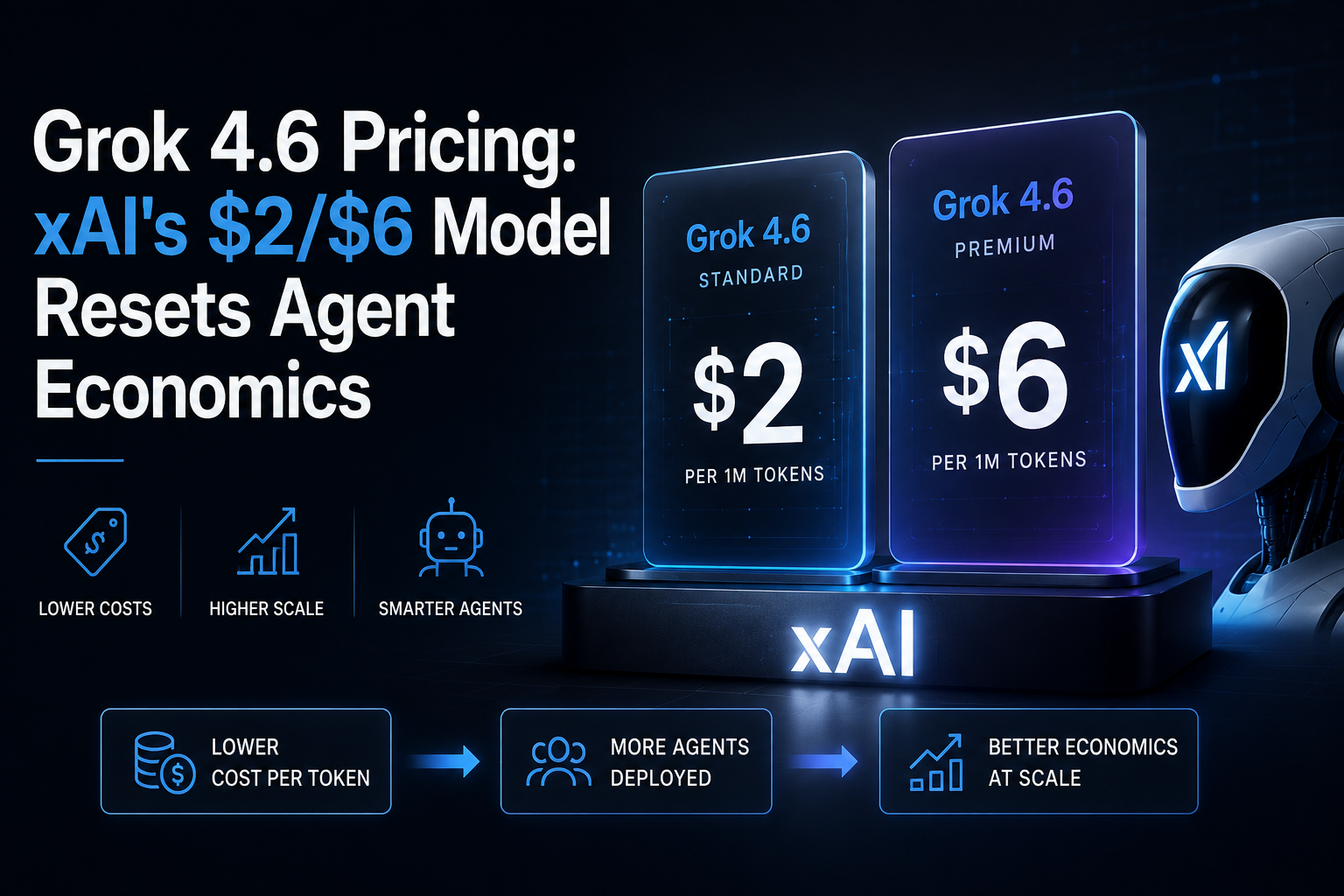
Grok 4.6 Pricing: xAI's $2/$6 Model Resets Agent Economics
Grok 4.6 launched on 12 August 2026 at $2 per million input tokens and $6 per million output tokens — roughly 60% cheaper than rivals like GPT-5.6 Sol ($5/$30) and Claude Opus 5 ($5/$25). With a 500K-token context window and strong agentic coding benchmarks, Grok 4.6 is the most cost-competitive frontier model available right now for agent builders watching unit economics.
Grok 4.6 pricing: key facts at a glance
- Standard rate: $2/M input tokens, $6/M output tokens for prompts under 200K tokens — unchanged from Grok 4.5.
- Long-context rate: once a prompt crosses 200K tokens, the entire request — input and output — reprices to $4/M and $12/M (eesel AI, 2026).
- Cached input got pricier: cached tokens rose from $0.30 to $0.50/M on the standard tier (a 67% increase), which mainly hits agent loops that lean on prompt caching (Digital Applied, 2026).
- Context window: 500,000 tokens, available via the xAI API, Grok Build, Cursor, OpenRouter, Vercel and Cloudflare.
- Benchmarks: Grok 4.6 scores 61 on the Artificial Analysis Intelligence Index, tying GPT-5.6 Sol and ranking third overall behind Claude Opus 5 (63) and Claude Fable 5 (62) (Artificial Analysis, 2026).
How much does Grok 4.6 cost via the API?
For any prompt under the 200,000-token mark, Grok 4.6 bills at $2 per million input tokens and $6 per million output tokens, with cached input tokens at $0.50 per million (xAI, 2026). Cross the 200K threshold and xAI doesn't just charge more for the overflow — it reprices the whole request to $4/M input and $12/M output, including cached tokens at $1.00/M (eesel AI, 2026).
That's an important detail for anyone budgeting a long-context agent: a 210K-token prompt is billed entirely at the higher tier, not blended.
xAI also offers Priority Processing at 2× the standard token price for latency-sensitive workloads, and ran a first-week promotion doubling included usage inside Grok Build and Cursor (xAI, 2026).
Grok 4.6 vs GPT-5.6 and Claude: pricing compared
| Model | Input ($/M) | Output ($/M) | |---|---|---| | Grok 4.6 | $2.00 | $6.00 | | GPT-5.6 Terra | $2.00 | $12.00 | | Claude Sonnet 4.6 | $3.00 | $15.00 | | Claude Opus 5 | $5.00 | $25.00 | | GPT-5.6 Sol | $5.00 | $30.00 |
Sources: xAI, Layer3 Labs, Apidog.
Grok 4.6's output pricing undercuts every model in its intelligence tier. GPT-5.6 Sol — the OpenAI model it ties on the Artificial Analysis Intelligence Index — costs five times as much per output token. Even against the mid-tier GPT-5.6 Terra, Grok 4.6's output rate is half the price for comparable input cost.
What's new in Grok 4.6 vs Grok 4.5?
Here's the detail that gets lost in the headlines: Grok 4.6's price is not a cut from Grok 4.5 — the $2/$6 standard rate is identical between the two versions (Digital Applied, 2026). "Half the price" refers to Grok 4.6 versus rival frontier models, not versus its own predecessor.
What actually changed is capability at the same price point: xAI says the release "builds on Grok 4.5 with a particular focus on long-running agents and more ambitious interactive and visual work" (xAI, 2026), reflected in benchmark gains like CursorBench v3.2 (69.9%) and DeepSWE v1.1 (65.9%).
Grok 4.6 benchmarks: how good is it, really?
On the Artificial Analysis Intelligence Index — a composite across coding, reasoning and knowledge tasks — Grok 4.6 scores 61, placing sixth out of 184 tracked models and tying GPT-5.6 Sol for third-best overall, behind only Anthropic's Claude Opus 5 and Claude Fable 5 (Artificial Analysis, 2026; VentureBeat, 2026).
Artificial Analysis puts Grok 4.6's cost-per-intelligence-task at $0.84 — cheap relative to peers of similar capability, though its raw output speed (65.8 tokens/second) ranks below average for the field.
Worth flagging: xAI's own comparison benchmarked Grok 4.6 at its default effort setting against competitors' maximum reasoning tiers — an asymmetry that inflates the apparent gap and is worth factoring in before treating "matches GPT-5.6 Sol" as an apples-to-apples claim (Digital Applied, 2026).
Why Grok 4.6 pricing matters for AI agent builders
Agent workloads live and die on token volume — a single multi-step agent run can chain dozens of tool calls, each one an input/output round trip. At GPT-5.6 Sol's rate, an agent generating 10 million output tokens a month costs $300 just in generation. The same run on Grok 4.6 costs $60. That gap compounds fast once you're running fleets of agents rather than single chat sessions, which is exactly the workload xAI is targeting with Grok 4.6's "long-running agents" focus (xAI, 2026).
Elon Musk framed the Grok 4.6 launch bluntly: "Grok 4.6 is objectively #1 when considering intelligence, speed & cost" (24/7 Wall St, 2026). Independent benchmarks are more measured — Grok 4.6 ranks third on raw intelligence, not first — but on the combined intelligence-per-dollar metric that matters most for agent unit economics, the claim holds up better than it first looks (Artificial Analysis, 2026).
The strategic pressure Grok 4.6 puts on OpenAI and Anthropic is real: both now face a frontier-adjacent competitor pricing output tokens at a fifth to a quarter of their flagship rate. Expect further price moves from both labs rather than an unanswered gap.
Is Grok 4.6 worth switching to for agent builders?
If your workload is output-token-heavy — long agent traces, code generation, multi-turn tool use — Grok 4.6's $6/M output rate is the standout number, especially against GPT-5.6 Sol's $30/M.
If your workload needs consistently low latency, Grok 4.6's below-average output speed (65.8 tokens/second per Artificial Analysis) is worth testing against your own traffic before committing.
And if you're already deep in long-context workflows above 200K tokens, model the Grok 4.6 long-context repricing carefully — it applies to the whole request, not just the overflow.
For UK SMEs evaluating their AI agent stack, the practical takeaway is straightforward: Grok 4.6 is the cheapest frontier-grade model available today for output-heavy workloads. Whether that translates to a switch depends on your actual token mix — input vs. output ratio, cache hit rate, and how often you'll cross the 200K threshold.
Grok 4.7: what's coming next?
xAI isn't stopping at Grok 4.6. Musk has said a substantially larger Grok 4.7 — reportedly a 2.1-trillion-parameter model — is due within weeks of the 4.6 launch, continuing an aggressive cadence that's seen three Grok releases in a single summer (American Bazaar, 2026). Pricing for Grok 4.7 hasn't been announced.
Grok 4.6 pricing: glossary
- Token — the basic unit LLM providers bill by; roughly ¾ of a word in English text.
- Context window — the maximum number of tokens a model can process in one request. Grok 4.6's is 500,000.
- Intelligence Index — Artificial Analysis's composite benchmark score across coding, reasoning and knowledge tasks.
- Long-context pricing — a higher per-token rate that kicks in once a request crosses a size threshold (200K tokens for Grok 4.6), applied to the entire request.
- Prompt caching — reusing previously processed tokens at a discounted rate. Grok 4.6 raised its cached token price from $0.30 to $0.50/M.
Frequently asked questions about Grok 4.6
How much does Grok 4.6 cost per million tokens?
$2 per million input tokens and $6 per million output tokens on prompts under 200,000 tokens. Above that threshold, the whole request reprices to $4/M input and $12/M output (xAI, 2026).
Is Grok 4.6 cheaper than GPT-5.6?
Yes — significantly. Against GPT-5.6 Sol, Grok 4.6's $6/M output rate is a fifth of Sol's $30/M. Against the mid-tier GPT-5.6 Terra ($2/$12), Grok 4.6 is still half the output price for comparable input cost (Layer3 Labs, 2026).
What is Grok 4.6's context window?
500,000 tokens, available via the xAI API, Grok Build, Cursor, OpenRouter, Vercel and Cloudflare (xAI, 2026).
Is Grok 4.6 better than Grok 4.5?
Grok 4.6 is priced identically to Grok 4.5 but scores higher on agentic coding benchmarks like CursorBench v3.2 and DeepSWE v1.1, with xAI positioning it specifically for long-running agent workloads (xAI, 2026).
Does Grok 4.6 beat GPT-5.6 and Claude on intelligence?
Not outright. Grok 4.6 ties GPT-5.6 Sol at 61 on the Artificial Analysis Intelligence Index, ranking third behind Claude Opus 5 (63) and Claude Fable 5 (62) (Artificial Analysis, 2026).
When is Grok 4.7 coming out?
xAI hasn't confirmed a date, but Elon Musk has said a much larger Grok 4.7 model is due within weeks of the Grok 4.6 launch (American Bazaar, 2026).
Should UK businesses switch their AI agents to Grok 4.6?
For output-token-heavy workloads — long agent traces, code generation, multi-turn tool use — Grok 4.6's $6/M output rate makes a compelling case. Model your actual token mix (input/output ratio, cache hit rate, long-context frequency) against your current provider's pricing before committing. If you'd like help evaluating your AI agent stack, our AI Readiness Audit maps your workflows and identifies where cost savings are realistic.