
Kimi K3: The Open Model That Just Closed the AI Gap
By The Radar Briefing — independent analysis for people who build with AI.
What is Kimi K3, in one paragraph?
Kimi K3 is a 2.8-trillion-parameter open-weight model from Chinese lab Moonshot AI, released on 16 July 2026. It uses a sparse mixture-of-experts design, a 1-million-token context window and native vision. It topped LMArena's Frontend Code Arena, beating Claude Fable 5 and GPT-5.6 Sol — at roughly a third of Fable's token price. Weights drop on 27 July.
TL;DR
- Kimi K3 tops the charts. It debuted at #1 on LMArena's Frontend Code Arena with 1,679 Elo, ahead of Claude Fable 5 (1,631) and GPT-5.6 Sol (1,618) (LMArena / Cryptobriefing, 2026).
- It's open, and it's the biggest. At 2.8 trillion parameters it is the largest open-weight model ever released; full weights land on 27 July under a Modified MIT licence (Cryptobriefing, 2026).
- It's cheap. Output runs $15 per million tokens versus $50 for Fable 5 — with cache-hit input as low as $0.30/MTok (MarkTechPost, 2026).
- Markets flinched. Nvidia dipped ~2% and Taiwan's index fell more than 6% as traders called it a second "DeepSeek moment" (Yahoo Finance, 2026).
- The takeaway for builders: if your agent stack is hard-wired to one frontier vendor, you are now overpaying. Multi-model routing just went from nice-to-have to table stakes.
Why is Kimi K3 such a big deal?
For two years the story of frontier AI was simple: the best models were closed, American, and expensive, and everyone else was playing catch-up. Kimi K3 breaks that story on all three counts at once.
Moonshot AI released it on 16 July 2026, and within hours it sat at the top of the Frontend Code Arena — the LMArena leaderboard where real developers vote, blind, on which model wrote the better front-end code. K3 scored 1,679 Elo, winning six of seven front-end domains and losing only "Gaming" to Fable 5 (The New Stack, 2026). That is a 17-place jump from the previous Kimi release.
The point is not that a Chinese lab reached the frontier. It is that it did so with an open-weight model you can download, at a price that undercuts the incumbents by a wide margin. As Moonshot's president Yutong Zhang put it, "We knew we didn't have the luxury to simply scale up compute. That forced us to focus on fundamental research and efficiency" (Fortune, 2026).
What can Kimi K3 actually do?
K3 is built for agentic and coding work, not just chat. The headline specs and benchmarks:
| Capability | Detail | |---|---| | Total parameters | 2.8 trillion (MoE, activates 16 of 896 experts) | | Context window | 1,000,000 tokens | | Modality | Text, images and video (native) | | Reasoning | Always-on "thinking mode" | | Frontend Code Arena | #1, 1,679 Elo | | Terminal Bench 2.1 | 88.3 | | BrowseComp (web agents) | 91.2 | | GPQA-Diamond (science) | 93.5 |
Source: MarkTechPost, 2026 and Cryptobriefing, 2026.
On practical automation, Moonshot reports K3 ranked first in four of eight real-world task benchmarks, including Automation Bench, SpreadsheetBench 2 and BrowseComp (VentureBeat / MLQ, 2026). The viral demos doing the rounds — a full playable game or a working web app from a single prompt — are the consumer-facing version of the same story: this model holds a plan together across many steps.
Two efficiency tricks explain how a lab under export controls got here. Kimi Delta Attention, a hybrid linear-attention mechanism, delivers up to 6.3× faster decoding in million-token contexts, and Attention Residuals add roughly 25% training efficiency at under 2% extra cost (MarkTechPost, 2026). Efficiency, not brute-force scale, is the moat now.
How much does Kimi K3 cost versus Claude and GPT?
This is where builders should pay attention. Per-token pricing for the flagship models:
| Model | Input ($/M) | Output ($/M) | |---|---|---| | Kimi K3 | 3.00 (cache-miss) / 0.30 cache-hit | 15.00 | | Claude Fable 5 | 10.00 | 50.00 | | GPT-5.6 Sol | 5.00 | 30.00 |
Sources: MarkTechPost, 2026; Finout, 2026.
On output tokens, K3 is roughly 3× cheaper than Fable 5 and 2× cheaper than GPT-5.6 Sol — before you factor in a reported 90%+ cache-hit rate in coding workloads, which pulls effective input cost down to pennies. And once weights ship on 27 July, self-hosting removes the per-token meter entirely for teams with the infrastructure to run a 2.8T-parameter model.
A caveat worth stating plainly: price per token is not price per finished task. A model that solves a job in fewer turns can be cheaper overall even at a higher sticker rate. The right comparison is cost-per-completed-task on your workload — which is exactly why you should be measuring, not guessing.
Why did AI stocks fall when Kimi K3 launched?
Because the market reads "open, frontier-level and cheap" as a threat to margins. On the day, Taiwan's benchmark fell more than 6%, Japan closed down 4%, and the Nasdaq slid ~1.5% in its worst session of the week (CNN Business, 2026). Nvidia dropped almost 2%, briefly slipping below Apple as the world's most valuable company (Yahoo Finance, 2026).
Traders reached for a familiar comparison: the DeepSeek shock of 2025, when a low-cost Chinese model briefly wiped hundreds of billions off chip valuations. Even Chinese rivals took the hit — Z.ai fell ~27% and MiniMax ~16% (Nikkei Asia, 2026). The signal for anyone building products: the cost of frontier-grade intelligence is falling faster than the incumbents' pricing implies.
What should agent builders do about it?
Do not rip out your stack and bet the company on a Chinese model that ships its weights next week. Do something more durable: stop being single-vendor.
The economics now clearly favour multi-model routing — a thin layer that sends each request to the right model for the job instead of one fixed default. Smart routing typically delivers 60–75% cost reduction while holding quality, and sending ~90% of easy traffic to a cheaper tier while reserving 10% for a frontier model can cut costs by around 86% with negligible quality loss (ScalaCode, 2026). A practical starting pattern:
- Planner / hard reasoning → a top-tier model (Fable 5, GPT-5.6, or K3 where it wins).
- Bulk tool-calls and code steps → Kimi K3 or another strong open-weight model.
- Cheap classification and routing → a small fast model.
- Fallbacks → at least two vendors, so a rate-limit or outage never stops the line.
Gateways like LiteLLM, Portkey and OpenRouter support this out of the box, so the engineering lift is a config change, not a rebuild (Mindra, 2026). The teams that win the next year won't be the ones loyal to a single lab — they'll be the ones who can swap a Kimi-class model in the moment it becomes the cheapest way to hit their quality bar.
The one-line version: model supremacy is over; model orchestration is the game. Kimi K3 just made that impossible to ignore.
Visual suggestions
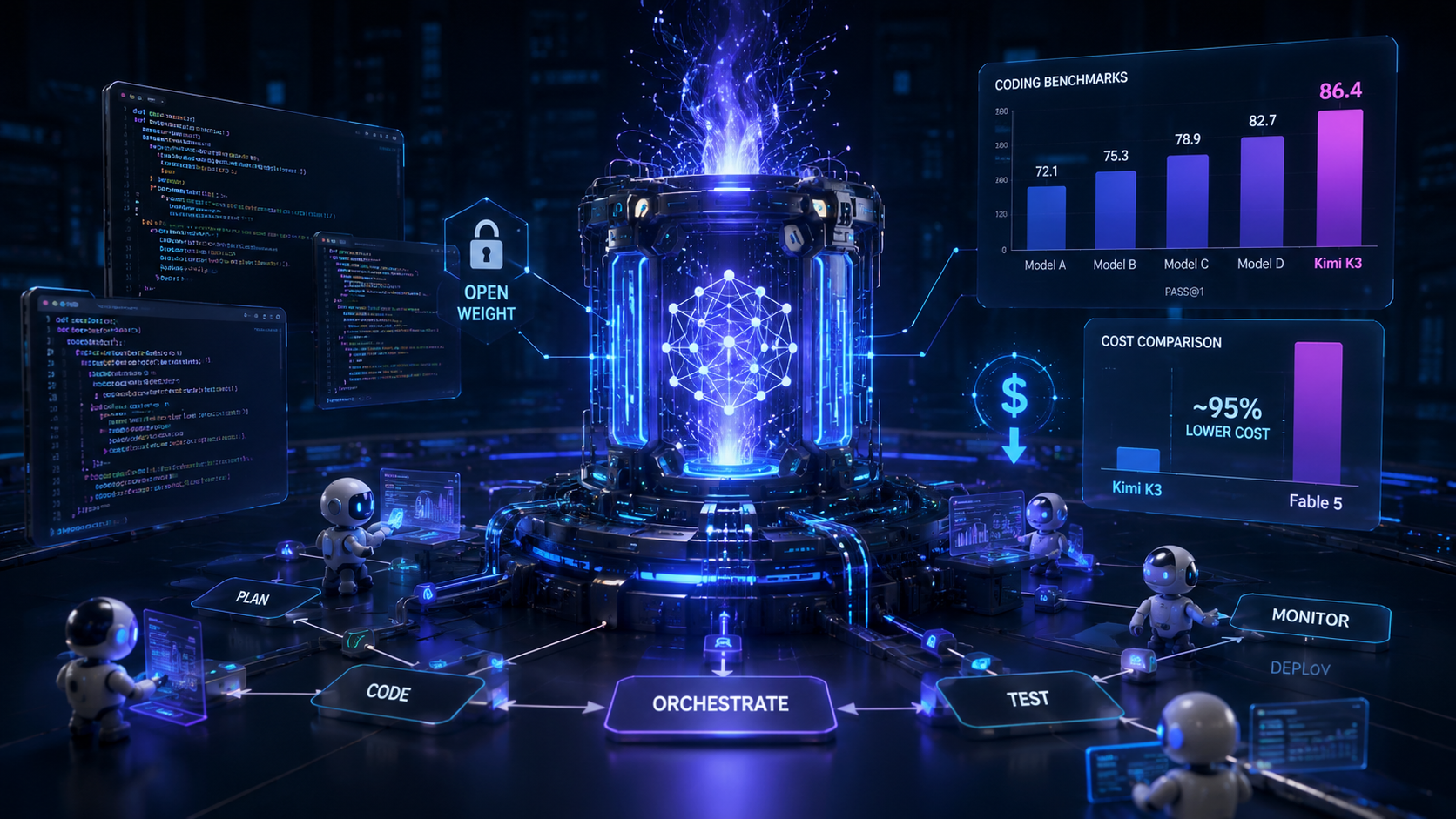
- Bar chart — "Output cost per million tokens": Kimi K3 ($15) vs GPT-5.6 Sol ($30) vs Fable 5 ($50). Alt-text: "Bar chart showing Kimi K3 output tokens cost roughly a third of Claude Fable 5." Caption: Frontier quality, budget pricing.
- Leaderboard snapshot — Frontend Code Arena top 3: K3 1,679 / Fable 5 1,631 / GPT-5.6 Sol 1,618. Alt-text: "Frontend Code Arena leaderboard with Kimi K3 in first place." Caption: Blind developer votes, not vendor claims.
- Routing diagram: request → router → (frontier / open-weight / small model) with fallbacks. Alt-text: "Diagram of a multi-model routing layer directing requests to different LLMs." Caption: One config layer, three tiers, big savings.
Frequently asked questions
Is Kimi K3 actually open source?
It is open-weight, not fully open source. Moonshot will publish the model weights on 27 July 2026 under a Modified MIT licence, letting developers download, run and fine-tune it. Training data and full training code are not part of the release (Cryptobriefing, 2026).
Can I use Kimi K3 right now?
Yes. Even before the weights drop, K3 is live via the app at kimi.com, Kimi Code, and the API (model ID kimi-k3 at https://api.moonshot.ai/v1). Self-hosting from downloaded weights becomes possible after 27 July (Cryptobriefing, 2026).
Is Kimi K3 better than Claude Fable 5?
On the Frontend Code Arena it ranked first, ahead of Fable 5, and Moonshot claims parity or better on several coding and agentic benchmarks. Fable 5 still leads in some categories (e.g. gaming code). Treat it as competitive at the frontier, not universally superior (Fortune, 2026).
How much cheaper is Kimi K3?
Output tokens cost $15 per million versus $50 for Fable 5 — about a third of the price — and cache-hit input can fall to $0.30 per million. Actual savings depend on your workload's cache-hit rate and how many turns each task takes (MarkTechPost, 2026).
Should I switch my agents to Kimi K3?
Not wholesale. The stronger move is multi-model routing: keep your best model for hard reasoning and route bulk steps to a cheaper model like K3. That captures most of the savings without a single point of failure (ScalaCode, 2026).
Why did Kimi K3 move the stock market?
Because a frontier-grade, open, low-cost model challenges the premium pricing baked into US chip and AI valuations. Nvidia fell ~2% and Asian tech indices dropped sharply as investors recalled the 2025 DeepSeek sell-off (Yahoo Finance, 2026).
Glossary
- Open-weight model: a model whose trained weights are published for download and fine-tuning, even if training data/code are not.
- Mixture-of-experts (MoE): an architecture that activates only a few specialised sub-networks ("experts") per token, cutting compute.
- Context window: the amount of text a model can consider at once — K3 handles 1 million tokens.
- Multi-model routing: a control layer that sends each request to the most suitable model by cost and difficulty.
- Elo (LMArena): a rating from head-to-head, human-voted comparisons; higher is better.
- Cache-hit: a repeated input the provider serves from cache at a steep discount.
The bottom line
Kimi K3 didn't just match the frontier — it made frontier-grade coding and agentic performance open and cheap on the same day, and the markets noticed. You don't need to adopt it blindly. You do need an architecture that can use it the moment the maths favours it. That means a routing layer, at least two vendors, and cost-per-task measurement on your own workloads.
Want the next Kimi-sized shift explained the day it lands — with the numbers and what to do about it? Subscribe to The Radar Briefing.