
Nvidia Buys Hugging Face for $13bn: UK SME Guide
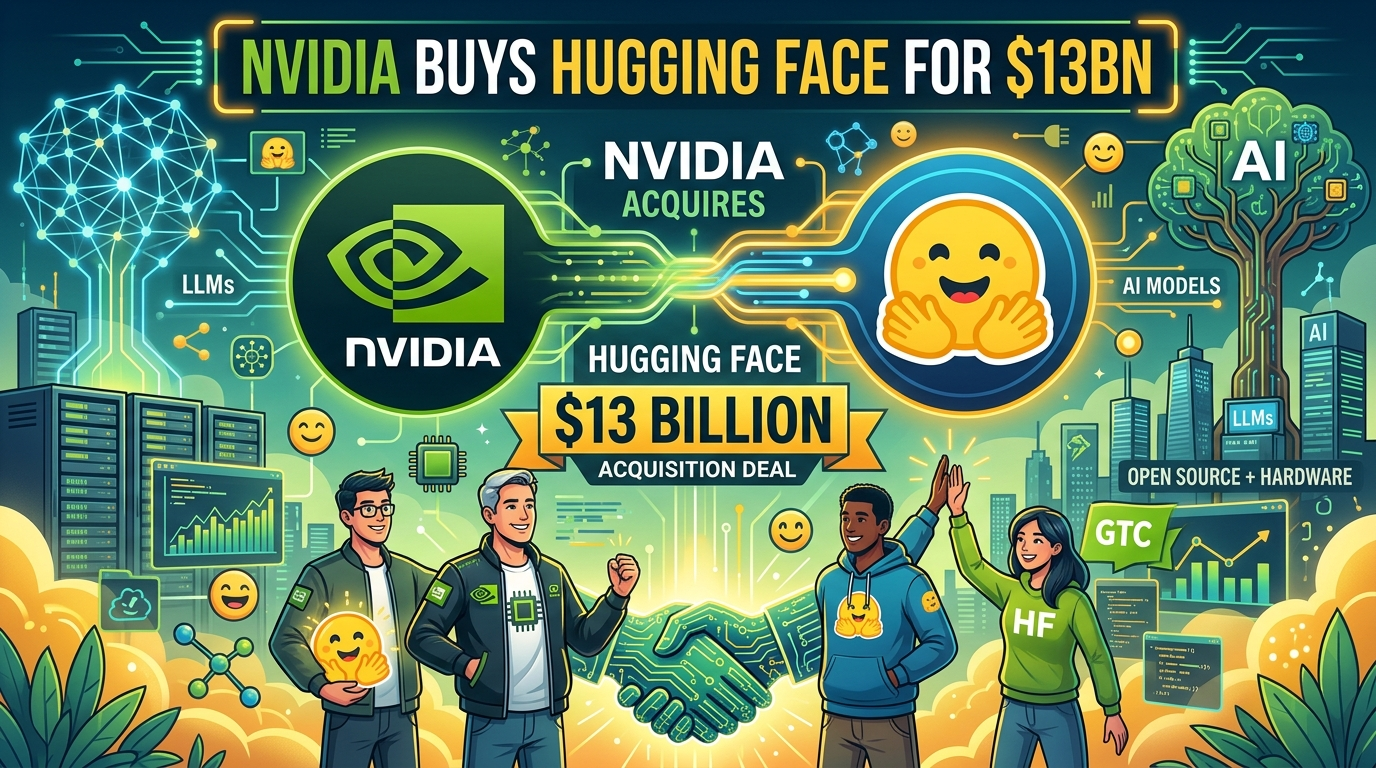
Nvidia has agreed to buy Hugging Face — the platform 18 million developers use to share and run AI models — for $12.9 billion. For UK SMEs, it means the open-source AI supply chain many businesses lean on for cheaper, customisable tools now sits inside one GPU giant's ecosystem, making a dependency review worth doing now, not later.
Nvidia Buys Hugging Face: Key Facts at a Glance
- Nvidia will pay $12.93bn for Hugging Face — $11.93bn to shareholders plus up to $1bn in retention equity for staff who join Nvidia, according to Nvidia's own announcement and Bloomberg.
- Hugging Face hosts 3 million-plus models and 500,000 datasets used by 18 million-plus developers across 200,000-plus companies — effectively the default distribution hub for open-source AI (Nvidia).
- It's Nvidia's second-largest acquisition ever, behind the $20bn purchase of Groq's assets in December 2025 (Bloomberg).
- Nvidia CEO Jensen Huang says Nvidia compute "will not be required" to build on or deploy through Hugging Face (TechCrunch).
- The deal is expected to close in the first half of 2027, subject to regulatory approval (CNBC) — which gives UK businesses a real window to check their own exposure.
What Did Nvidia Actually Buy?
Hugging Face isn't a single AI model — it's closer to a GitHub for AI: a hub where developers store, discover, compare and download open and open-weight models, datasets and demo apps. Founded in New York in 2016 by Clément Delangue, Julien Chaumond and Thomas Wolf (Wikipedia), it has become the place most builders go first when they need a model rather than a proprietary API.
Nvidia's own numbers put that reach at over 18 million developers, more than 3 million models and 500,000 datasets, with over 200,000 companies using the platform to find and deploy AI (Nvidia). That scale — not a single flagship model — is what Nvidia paid for.
Why Is Nvidia Buying Hugging Face Now?
Nvidia isn't acting in isolation. The same week, cloud-computing provider Crusoe closed a $3bn round at a $30bn valuation to expand AI infrastructure (Bloomberg), and Stripe had just moved to acquire the model-routing platform OpenRouter (VentureBeat). Read together, it's a land grab for the distribution layer of AI — the point where developers choose what to build with — not just the compute underneath it.
The deal itself had been building for years: Hugging Face reportedly turned down a $500 million Nvidia offer previously, and this time Hugging Face CEO Clém Delangue approached Nvidia's Jensen Huang directly (CNBC). Delangue explained the logic plainly: "for it to happen at [a] larger scale, it needs more compute, more support, more collaboration, and more visibility. That's why we went to talk to Jensen, who offered to do exactly that with us" (TechCrunch).
What Has Nvidia Promised Will Change — or Not?
Aware that developers chose Hugging Face partly because it was neutral ground, Huang's announcement leant heavily on continuity. He committed that "developers will choose the models they want, the frameworks they want, the clouds and inference service providers they want and the computing platforms they want. Nvidia compute will not be required to build on or deploy through Hugging Face" (TechCrunch). Hugging Face is also set to keep its independent operating model, its multi-cloud support and its 🤗 branding (Nvidia).
Those are unusually specific commitments for an acquisition announcement, which is why early reaction has been mixed rather than uniformly hostile. But commitments made at signing aren't the same as terms enforced two years into ownership — and that gap is exactly what UK SMEs need to plan around.
What Does the Hugging Face Acquisition Mean for UK SMEs?
Plenty of UK SMEs already touch Hugging Face without realising it — through open-weight models embedded in a vendor's product, or because a developer chose a free, self-hosted model over a metered API to control cost. The appeal of open models was always partly about not being locked into one supplier's pricing or roadmap.
That protection just got thinner. As one analysis of the deal puts it: "Lock-in at this layer never arrives as an announcement. It arrives as an optimisation" (Resultsense) — meaning the risk isn't a sudden policy change, it's a slow drift toward whichever tools are most convenient on Nvidia-owned infrastructure. Model weights remain portable in principle, but the tooling, hosting and discovery layer around them — the part most UK SMEs actually depend on day to day — now sits under a single commercial owner with its own interests.
Is Open-Source AI Still Safe for a UK Business to Build On?
Yes, for now — but "safe" and "static" aren't the same thing. Nvidia has strong commercial reasons to keep Hugging Face open: alienating 18 million developers would destroy the asset it just paid $12.9bn for. Even so, independent analysts have cautioned that Nvidia's neutrality commitments can't really be tested until well after the deal closes and integration begins (InfoWorld).
For a UK SME, the sensible read is: nothing breaks today, but a stack built on the assumption that Hugging Face is neutral infrastructure now needs the same scrutiny you'd give any single-vendor dependency.
How Should a UK SME Respond to the Nvidia-Hugging Face Deal?
The businesses best placed to handle this aren't the largest ones — they're the ones that act while the deal is still in its regulatory-approval window, which runs to the first half of 2027 (CNBC). Recommended first steps (Resultsense):
- Inventory your AI dependencies — document exactly which models, versions and sources your tools and workflows actually use.
- Mirror critical assets locally — store weights, tokenizers and datasets you rely on in your own registry, with checksums, so you're not solely dependent on one host.
- Separate licensing risk from platform risk — an open licence doesn't protect you if the distribution layer changes; treat them as two different questions.
- Benchmark support quality now — so you have a baseline to notice if service quality quietly drifts after the acquisition closes.
- Cost out a switching scenario — know roughly what it would take to move to a different model family or hosting route before you ever need to.
A small business can typically complete a full model-and-tool inventory in an afternoon — well before most larger competitors have even finished scoping the exercise. If you'd rather have that dependency map built for you, our AI Systems Audit reviews exactly which third-party AI infrastructure your business relies on and where the concentration risk sits.
Frequently Asked Questions
What is Hugging Face and why does it matter to my business?
Hugging Face is the leading hub for open-source AI models, datasets and apps, used by over 18 million developers and 200,000 companies to find and deploy AI tools (Nvidia). If your business or your software vendors use open-source AI, you're almost certainly touching Hugging Face already.
How much is Nvidia paying for Hugging Face?
Nvidia agreed to pay $12.93 billion in total — $11.93bn to Hugging Face shareholders plus up to $1bn in retention equity for employees joining Nvidia (Bloomberg).
Will Hugging Face's open-source models still be free after the Nvidia deal?
Nvidia has said Hugging Face will remain open, with no requirement to use Nvidia compute or hardware (TechCrunch). Existing open licences don't change, though the platform's future direction is now Nvidia's to steer.
Does my UK business need to migrate away from Hugging Face right now?
No — the deal hasn't closed and nothing changes immediately. But it's a sensible moment to inventory your AI dependencies and understand your exposure while the deal is still going through regulatory review.
When will the Nvidia-Hugging Face deal close?
Nvidia expects the acquisition to close in the first half of 2027, subject to customary closing conditions and regulatory approval (CNBC).
Is this the same as Nvidia buying an AI model or chatbot?
No. Nvidia bought the distribution platform — the hub where models, datasets and apps are hosted, shared and discovered — not a specific model or consumer AI product (Nvidia).
What should I actually do this week as a UK SME?
Start with a simple inventory: list every AI model, dataset or open-source tool your business or vendors currently rely on, and note whether it comes via Hugging Face. That single step tells you how exposed you are.
Key Terms Explained
- Open-weight model — an AI model whose trained parameters are published for anyone to download and run, as distinct from a closed model only accessible via a paid API.
- Model hub — a platform (like Hugging Face) for storing, discovering and sharing AI models and datasets.
- Vendor lock-in — dependency on a single supplier that makes switching costly or impractical.
- Inference — running a trained AI model to generate an output, as opposed to training it.
- Retention equity — shares granted to a target company's staff to encourage them to stay on after an acquisition.
Nvidia-Proofing Your AI Stack: Get an AI Systems Audit for Your UK Business
Nvidia's $12.9bn purchase of Hugging Face is a reminder that the "open" layer of AI has an owner now, and it's worth knowing exactly where your business sits on top of it. An AI Systems Audit maps every third-party AI dependency in your stack and flags concentration risk before it becomes a problem — book a free AI Workflow Blueprint call to get started.