
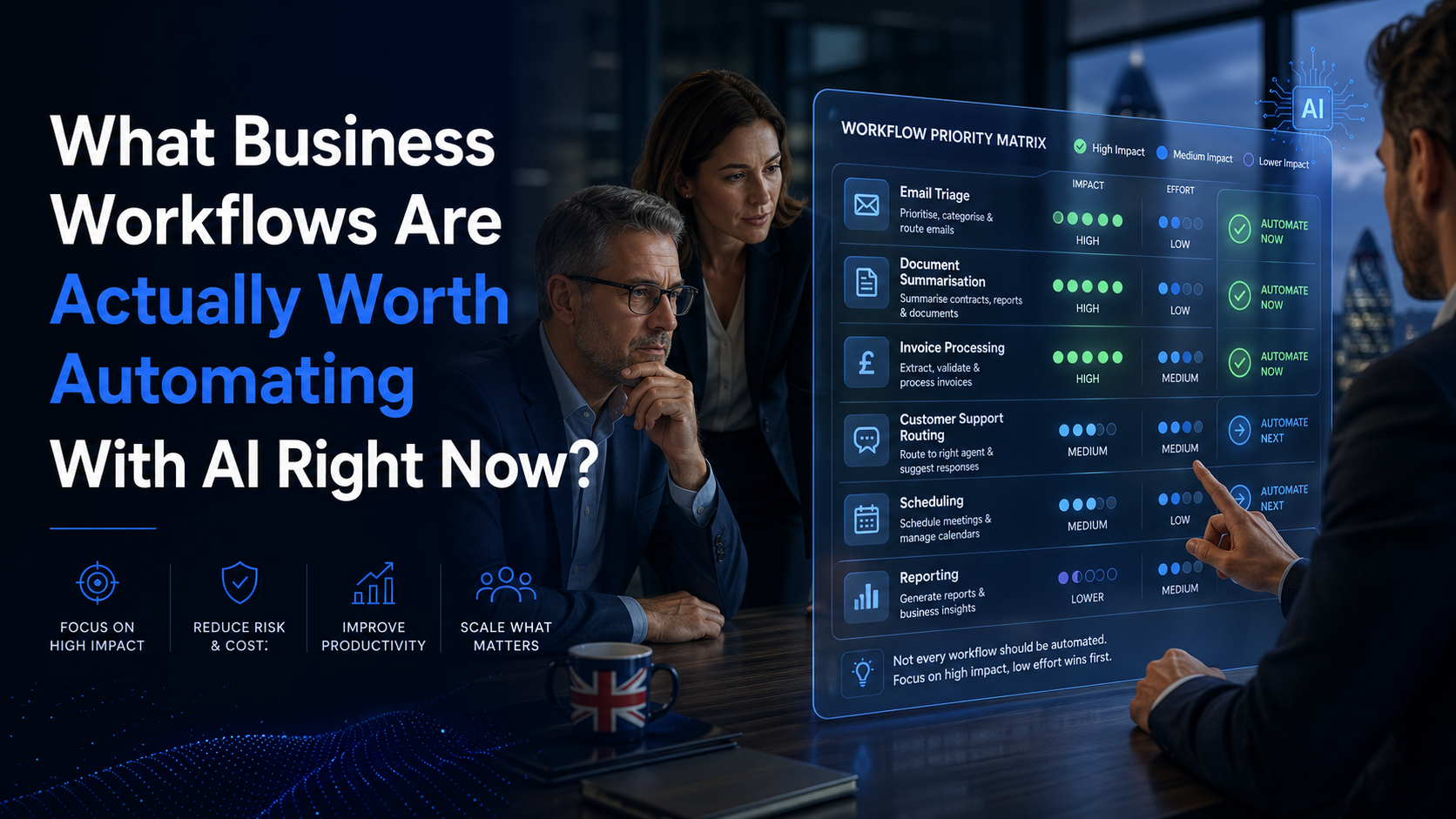
Most small business owners know AI could help them. The problem is not motivation. It is knowing where to start without wasting money on something that does not move the needle.
This guide cuts through the noise. You will find out which business workflows are genuinely worth automating with AI right now, which ones are overhyped, and how to decide where your business should focus first.
Why Most SMEs Get This Wrong The most common mistake is starting with the most exciting-sounding AI application rather than the most painful problem in your business.
You end up with a chatbot nobody uses, or an AI writing tool that saves 20 minutes a week, while your team is still manually copying data between spreadsheets for three hours every day.
Good AI automation prioritises time, repetition, and cost. Not novelty.
The Simple Test: Is a Workflow Worth Automating? Before you automate anything, run it through three quick questions:
Does this task happen repeatedly? Daily, weekly, or at high volume is ideal. Does it follow a predictable pattern? If the steps are mostly the same each time, AI can handle it. Is a person doing it mainly because no one has set up a system yet? That is your clearest signal. If you answer yes to all three, that workflow is a strong candidate. If the task requires nuanced human judgement every single time, it is probably not the right place to start.
Workflows That Deliver Real ROI in 2026 These are the areas where SMEs are seeing measurable results, not just interesting demos.
- Inbox Triage and Email Responses For businesses handling high volumes of enquiries, AI can read incoming emails, categorise them, draft responses, and flag urgent items for human review.
A care home admin team spending two hours a day on routine email correspondence can cut that down significantly. The time goes back to staff. The response speed improves for families and residents. Both matter.
- Candidate Screening and Recruitment Admin Medical recruitment is one of the clearest use cases. Sifting through CVs, sending acknowledgement emails, scheduling interviews, and chasing references are all highly repetitive tasks.
AI Advisers worked with a medical recruitment client and delivered ROI within one month by automating exactly this kind of admin. The recruiter's time shifted from processing paperwork to building relationships and placing candidates.
- Scheduling and Appointment Management Whether you run a trades business in Northampton or a care service in Bedford, managing appointments manually is a time drain. AI tools can handle booking confirmations, reminders, rescheduling requests, and calendar updates without a human touching each one.
The knock-on effect is fewer no-shows, less back-and-forth, and staff freed up for work that actually requires them.
- Reporting and Data Entry Pulling data from one system, formatting it, and dropping it into a report is exactly the kind of task that eats hours and adds no thinking value. AI can do this reliably, consistently, and faster than any person.
For SMEs in automotive trades or professional services, this often means end-of-week reports, job costing summaries, or compliance documentation that currently takes half a day to produce.
- Customer Enquiry Handling A well-configured AI assistant on your website or messaging platform can answer common questions, qualify leads, and route complex queries to the right person. This works particularly well outside business hours, when enquiries would otherwise sit unanswered until morning.
This is not about replacing your team. It is about making sure no enquiry falls through the gap.
Workflows That Are Overhyped Right Now Not everything deserves automation. Some applications sound impressive but deliver little for a 10 to 50 person business.
Fully autonomous AI decision-making for anything involving risk, compliance, or client relationships is not ready for most SMEs and introduces liability you do not want.
AI-generated social media content at scale often produces generic output that damages your brand more than it helps. A human voice still wins on LinkedIn and Facebook for local businesses.
Complex AI analytics dashboards built before you have clean, consistent data are expensive and unreliable. Fix your data quality first.
The rule: do not automate a broken process. You will just produce broken results faster.
How to Prioritise Where to Start If you are running a business in Milton Keynes, Luton, or anywhere across the East Midlands, here is a practical way to prioritise.
Step 1: List your five most time-consuming admin tasks. Ask your team, not just yourself. They know where the friction is.
Step 2: Score each one. How often does it happen? How long does it take? How predictable is it? The highest-scoring task is your starting point.
Step 3: Start small. Automate one workflow, measure the result, then expand. You do not need to overhaul everything at once.
Step 4: Get an outside view. An AI readiness audit gives you a structured assessment of where automation will actually make a difference in your specific business. It removes the guesswork.
At AI Advisers, the process starts with a free 30-minute consultation. You talk through your operations, and the team identifies where AI can deliver measurable results, typically within weeks rather than months.
FAQs What types of business workflows are best suited to AI automation? Workflows that are repetitive, high-volume, and follow a consistent pattern are the best fit. Email triage, scheduling, data entry, candidate screening, and routine customer enquiries all meet these criteria for most SMEs.
How do I know if AI automation will actually save my business money? The clearest signal is staff time. If a task takes several hours per week and follows predictable steps, automating it usually delivers a positive return within weeks. An AI readiness audit can give you a specific estimate for your business.
Is AI automation only for large companies? No. Most of the practical gains in 2026 are happening at the SME level. The tools are more accessible and affordable than they were two years ago, and the workflows that benefit most are common in businesses with 5 to 50 employees.
What is the biggest mistake SMEs make when starting with AI automation? Starting with the most exciting application rather than the most painful problem. The best ROI usually comes from fixing a mundane, repetitive task that nobody enjoys doing.
How long does it take to see results from AI workflow automation? For well-chosen workflows, most SMEs see measurable results within a few weeks of implementation. Complex integrations take longer, but the starting point should always be something achievable quickly.
Do I need technical expertise to automate workflows with AI? No. A good AI consultant handles the technical side and explains everything in plain language. Your job is to describe how your business works, not to understand the underlying technology.
What about AI regulations? Do I need to worry about compliance? Yes, and it is worth taking seriously. The EU AI Act has implications for UK SMEs depending on how and where you use AI tools. Working with a consultant who includes governance and compliance guidance means you stay on the right side of emerging rules.
Start With What Actually Matters The businesses seeing real results from AI in 2026 are not the ones chasing the latest tools. They are the ones who identified one painful, repetitive workflow, automated it properly, and built from there.
You do not need a big budget or a technical background. You need a clear view of where your time is going and a practical plan to get some of it back.
Learn more at aiadvisers.co.uk and book your free 30-minute consultation to find out exactly where AI can make a difference in your business.